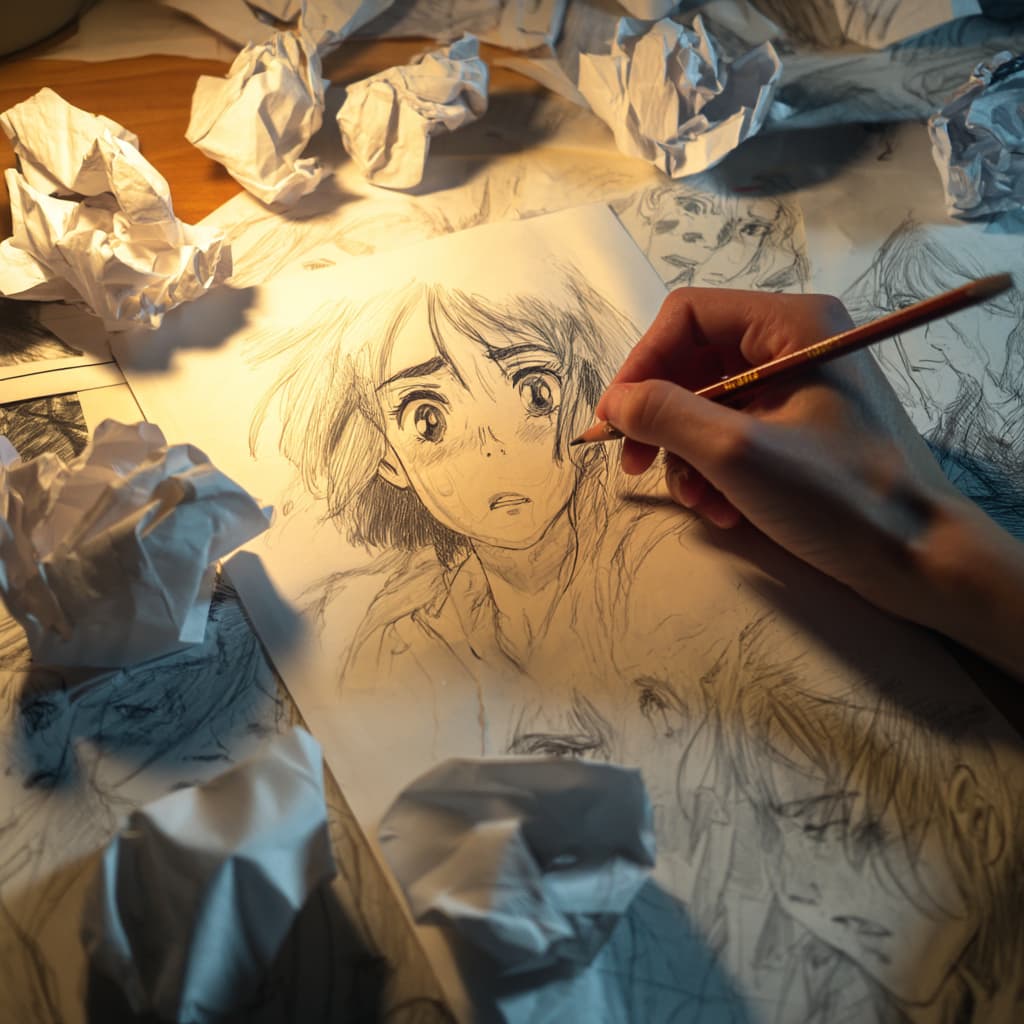
Many illustrators believe that exhaustion comes from long hours at the tablet, repetitive hand movements, or tight deadlines. Physical fatigue is real, but in most professional creative work, the deeper exhaustion is cognitive. Illustrators often feel drained not because they have been drawing, but because they have been choosing.
Every illustration is built on a chain of decisions. Before a single line is finalized, the artist has already selected a concept, defined the mood, determined the format, chosen references, and imagined multiple possible directions. During execution, the decisions continue. Composition, perspective, character pose, color palette, lighting logic, texture density, level of detail, typography integration, and countless micro adjustments must all be resolved.
Each decision consumes mental energy. Over time, this accumulation leads to what psychologists call decision fatigue. In creative work, this fatigue can quietly reduce clarity, confidence, and originality.
The Invisible Load of Micro Decisions
When looking at a finished illustration, it appears unified and effortless. What remains invisible is the number of alternatives that were rejected. A professional illustrator rarely follows the first idea that comes to mind. They test thumbnails. They experiment with balance. They compare focal points. They adjust scale relationships. They reconsider contrast. They refine rhythm.
Individually, these micro decisions seem minor. Together, they create significant cognitive load. The brain must evaluate options, predict outcomes, and maintain consistency across the image. This continuous evaluation process is far more mentally demanding than the physical act of drawing lines.
In fact, many illustrators report that once major decisions are locked in, execution feels almost relaxing. The exhausting part occurs earlier, during uncertainty.
The Paradox of Unlimited Choice
Creative professionals today operate in an environment of abundance. There are thousands of brushes, infinite color combinations, endless reference libraries, and constant exposure to other artists’ work. Software offers unlimited undo, layers, filters, and effects.
While these tools expand possibilities, they also increase decision pressure. When options are unlimited, choosing becomes harder. The question shifts from “Is this good?” to “Is this the best possible option?” That mental comparison can become paralyzing.
Unlimited choice amplifies self doubt. Instead of trusting instinct, illustrators may keep exploring alternatives long after a strong solution has already emerged. This prolongs projects and intensifies fatigue.
Emotional Consequences of Decision Fatigue
Decision fatigue does not only slow workflow. It affects emotional stability. As mental energy decreases, confidence tends to drop. Small revisions feel heavier. Feedback feels more threatening. The ability to evaluate one’s own work objectively diminishes.
Common signs include:
Difficulty selecting the strongest sketch among several solid options.
Overworking details without improving clarity.
Frequent switching between concepts without commitment.
Procrastination at the beginning of new projects.
Settling for safe solutions instead of bold ideas.
When fatigue accumulates, creativity may feel blocked. In reality, the imagination is not empty. The cognitive system is simply overloaded.
Why Illustrators Are Especially Vulnerable
Unlike many professions, illustration requires continuous aesthetic judgment. There is rarely a single correct answer. Most decisions are subjective and contextual. This ambiguity increases mental strain.
In addition, freelance illustrators often work alone. Without structured feedback loops, they must self direct and self evaluate. This means they carry both the creative and critical roles simultaneously.
Commercial projects add another layer. Illustrators must anticipate client expectations, brand alignment, and audience reaction while also maintaining personal standards. Balancing these perspectives multiplies decision complexity.
The Role of Workflow Systems
One of the most effective ways to reduce decision fatigue is to create structured systems. Systems limit unnecessary choice and protect mental energy for high level thinking.
For example, some illustrators define a fixed primary palette for a project before detailed work begins. Others restrict themselves to a small set of trusted brushes instead of experimenting constantly. Some establish a clear sequence such as thumbnail, refined sketch, value study, color blocking, and final detailing.
When workflow becomes predictable, the brain no longer needs to decide how to proceed at every stage. It can focus on solving the creative problem itself.
Systems do not reduce creativity. They protect it.
Style as a Decision Filter
A well developed personal style acts as a filter. When an illustrator understands their visual language, many decisions become automatic.
For instance, if an artist consistently uses simplified geometry and flat color areas, they are less likely to debate hyper realistic shading techniques. If their style relies on expressive line work, they do not need to evaluate every possible rendering method.
Style reduces cognitive noise. It narrows the field of acceptable solutions and speeds up judgment. This is one reason why experienced illustrators often work more efficiently than beginners. Their aesthetic framework guides them.
Time Constraints as a Creative Tool
Interestingly, moderate time constraints can reduce decision fatigue. When time is unlimited, exploration expands indefinitely. When deadlines are clear, the brain prioritizes faster resolution.
Professional illustrators sometimes set internal time limits for specific stages. For example, thirty minutes for thumbnail exploration. One hour for color testing. After that, a decision must be made.
This practice prevents endless comparison and encourages intuitive confidence.
Separating Exploration from Evaluation
Another strategy is to separate idea generation from critical assessment. During early brainstorming, the goal is quantity without judgment. Later, evaluation becomes structured and analytical.
Mixing these phases increases fatigue because the brain constantly switches modes. Clear separation reduces friction and improves clarity.
Physical and Mental Energy Management
Decision fatigue is also linked to general energy levels. Complex creative decisions require mental freshness. Many illustrators notice that strategic thinking is strongest in the first hours of the day.
Placing concept development earlier and reserving repetitive refinement tasks for later can improve sustainability. Short breaks, physical movement, and distance from the screen also help reset cognitive resources.
The Long Term Perspective
Understanding decision fatigue reframes creative exhaustion. It shifts the narrative from “I am not talented enough” to “My cognitive resources are depleted.” This distinction is empowering.
Illustration is not only about drawing skill. It is about managing attention, energy, and judgment over time. Professionals who recognize this build healthier practices.
They design systems. They reduce unnecessary choices. They trust their visual language. They accept that not every decision requires perfection.
Conclusion
Illustrators rarely burn out from the physical act of drawing. They burn out from constant evaluation, comparison, and choice. Every composition shift, color adjustment, and stylistic consideration consumes mental energy.
Decision fatigue is not a weakness. It is a natural consequence of complex creative work. By structuring workflow, limiting options strategically, and protecting cognitive resources, illustrators can maintain clarity and confidence.
When choice becomes intentional rather than overwhelming, creative work regains its sense of flow. Drawing becomes lighter. Decisions become sharper. And the illustrator’s energy is directed where it matters most, toward meaning, storytelling, and visual impact.